
Medical trolley: buying guide
37 products in the catalogue
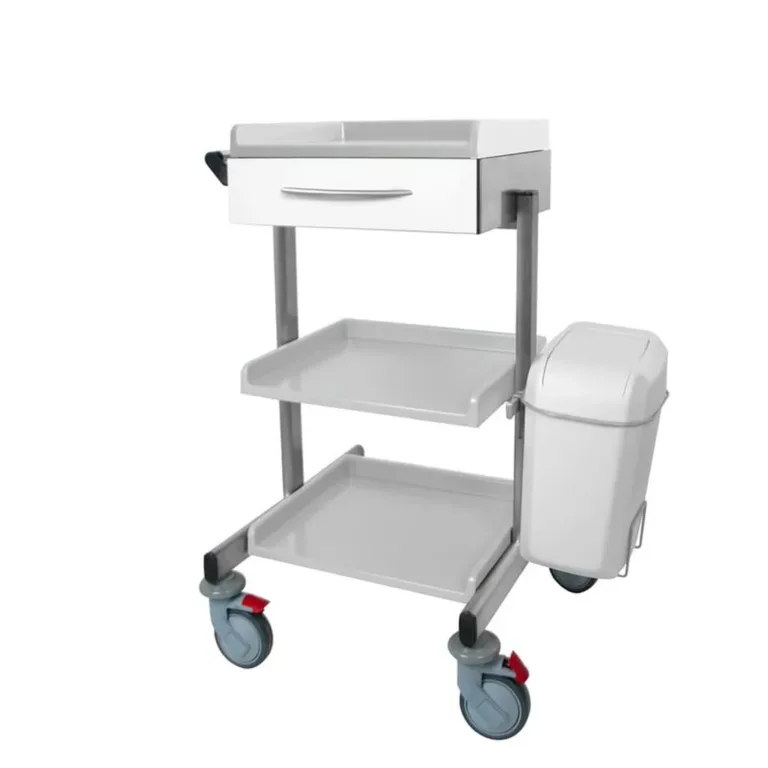
A medical trolley is a mobile workstation that brings together in a single unit the work surface, storage and accessories that the clinician needs to hand. The range includes utility trolleys with trays, dressing trolleys, trolleys for medical equipment, an oxygen cylinder holder, modular trolleys with drawers, an emergency trolley and a compact paediatric trolley.
The choice revolves around three decisions: the type of trolley according to use (dressings, equipment, medication or emergency), the internal organisation (drawers, trays, shelves or cassettes) and mobility (castors, brakes and working height). To these are added the material, the accessories that mount on the frame and the real space available in corridors and rooms. This guide sets out those criteria so that similar references can be compared.

Other related families
-
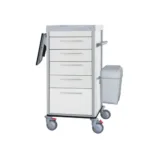 Medical Dressing Trolleys
Groups the drawer and accessory configurations used for dressings on wards and in consulting rooms.
-
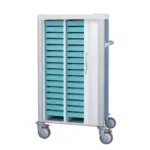 Unit-dose Medication Trolleys
For those who distribute individualised medication per patient and need identified cassettes or compartments.
-
 MRI Trolleys
A specific family of trolleys for the magnetic resonance imaging environment.
-
 Stainless Steel Trolleys
Useful in departments that prioritise the durability of the material.
Products in this guide
- Aluminium 13
- Stainless steel 10
- ABS 4
- Polyurethane 1
- Medical device 19
- Non-medical 17
- Italy 22
- UE 1
-
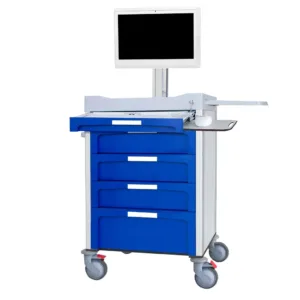
Telemedicine Trolley with Integrated Monitor and Camera, Antimicrobial Keyboard and Mouse IP68 and 5 Swivel Castors Ø125 mm | DNOVMED Platform for Video Consultation and Telecare (Ref. CMLP-F-DNOVMED-1-3-1-AZ)
In stockRequest a quote -
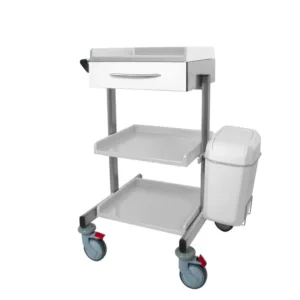
Auxiliary medical equipment trolley in AISI 304 stainless steel with 3 ABS shelves and optional drawer (Ref. CMLP-F-MTB-INOX)
In stockRequest a quote -
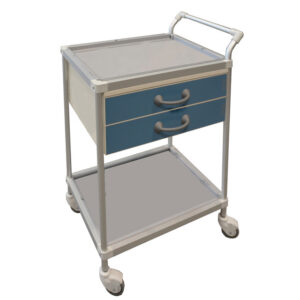
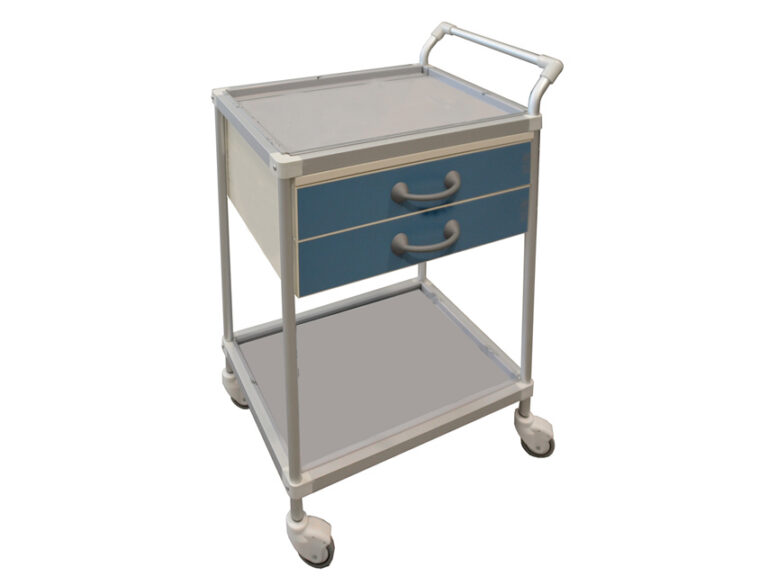
Deluxe medical trolley with 2 drawers – 65 x 45 x H 80 cm, lightweight anodised alloy and stainless steel shelves · Ref. 27422 (SKU GM27422)
570,00 € In stockAdd to basket -
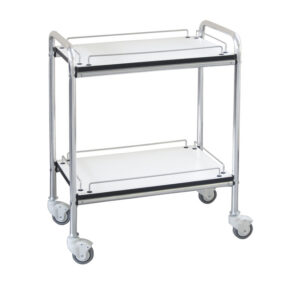
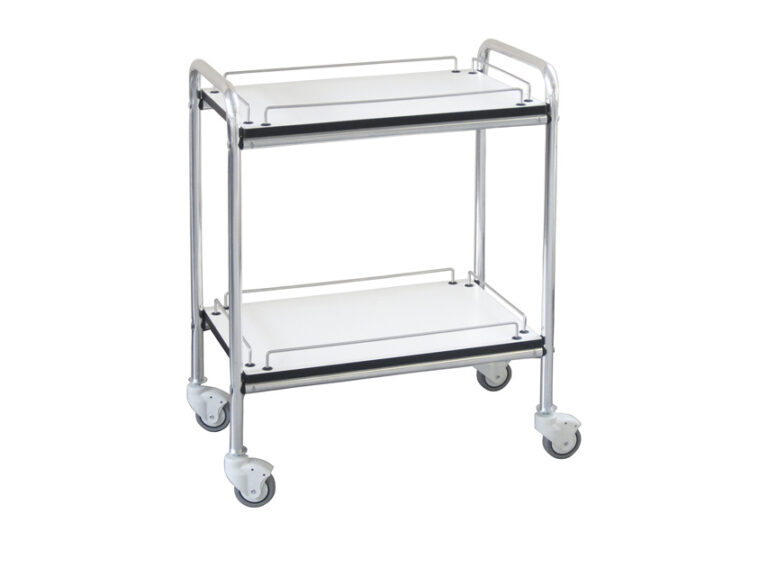
Medical trolley MODEL 2 with guard rail – Auxiliary trolley with 2 shelves, aluminium structure, 70x50xh 78 cm (Ref. GM27425-F)
Price range: 289,75 € through 327,75 € In stockSelect options This product has multiple variants. The options may be chosen on the product page -
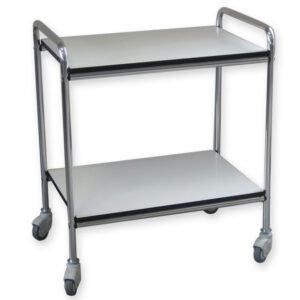
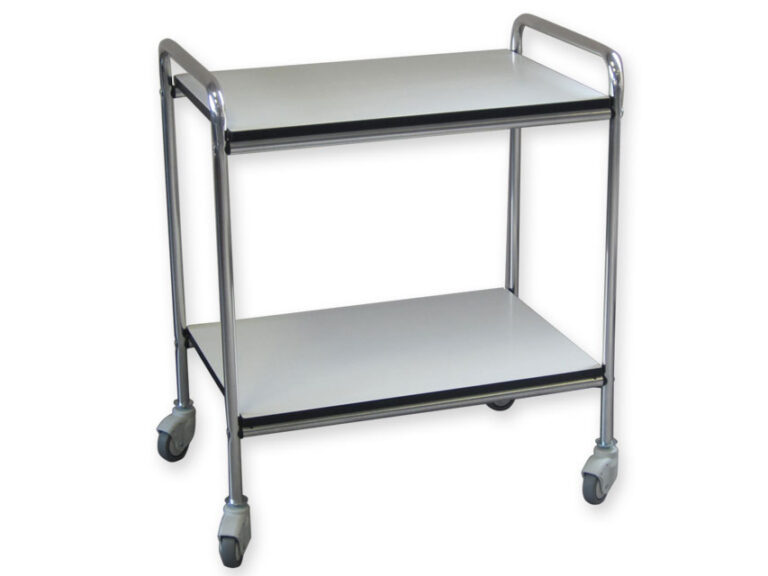
Medical trolley MODELO 3 without guard rails – Medium size (70 × 50 × H 78 cm) in aluminium with 2 shelves and nylon wheels | Ref. 27426
285,00 € In stockAdd to basket -
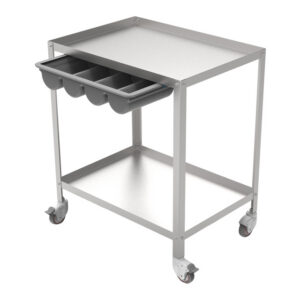
AISI 304 stainless steel auxiliary trolley with plastic drawer with 4 compartments and 2 shelves with raised edges, 4 rubber castors Ø 80 mm (Ref. 27430)
332,50 € In stockAdd to basket -
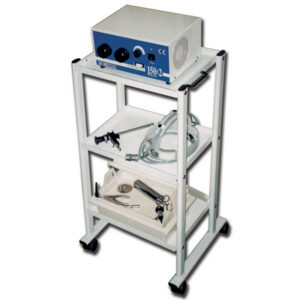
TRIS medical trolley for ECG, electrosurgery and diagnostic equipment · 2 shelves · 4 swivel nylon castors · Load 39 kg · Ref. 27438
198,55 € In stockAdd to basket -
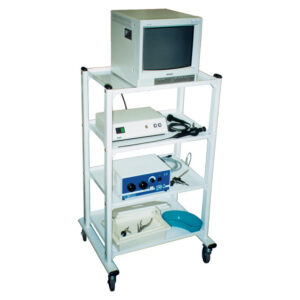
EXCEL trolley for medical equipment – 3 shelves 60×45 cm, max. load 80 kg (Ref. GM27440)
Price range: 438,90 € through 489,25 € In stock🚚 Bulky deliverySelect options This product has multiple variants. The options may be chosen on the product page
Buying and selection tips
-
Choose the type of trolley first
There are utility trolleys with trays, dressing trolleys, trolleys for monitors and medical equipment, modular trolleys with drawers, an oxygen cylinder holder and an emergency trolley. Settle the main use before comparing dimensions and accessories.
-
Match drawers, trays and shelves to the contents
Trolleys combine drawers of different heights, trays and adjustable shelves. Count the material that has to be housed and check the height and capacity of each drawer in the specific reference.
-
Castors, brakes and working height
Check the castor diameter, which ones have brakes and the height of the work surface, so that the trolley moves along the intended corridors and stays stable at the point of use.
-
Plan the accessories
Some trolleys accept accessories on a side rail, such as a waste bin, glove holder or side tray, and others have a power socket with cable management. Verify which accessories each reference includes and which are ordered separately.
-
Check the material and the cleaning instructions
The trolleys in the range are made of aluminium, steel and PVC, among other materials. Consult the manufacturer's instructions for cleaning and maintenance.
Compatibility
- Removable side tray
- Extends the preparation surface; verify that the chosen reference supports it.
- drip stand
- Mounts on the trolley in some references; before combining it with other accessories, decide the fixing point.
- Unit-dose cassettes
- Some trolleys house removable cassettes; verify the dimensions of the cassette before combining it with the trolley body.
- Suction canisters
- Some trolleys are designed to hold suction canisters; check compatibility with the systems the facility already uses.
Frequently asked questions
Which drawer configuration suits ward dressings and which suits a consulting room?
It depends on the material to be housed and the space available. For ward dressings, greater storage capacity is usually of interest; in consulting rooms with limited space, a more compact trolley. Check the configuration of each reference.
What should I check on the castors of a medical trolley?
The diameter, how many castors have brakes and the swivel. Check that this specification fits the intended use and the floors it will travel over.
What advantage does a removable modular cassette offer over a conventional drawer?
The cassette comes out completely, which speeds up filling and transfer of the contents. Check the characteristics of the cassette in each reference.
When is a trolley with a power socket worthwhile?
When the trolley will house medical equipment that needs a power supply. Verify the cable management and the socket of the reference.
Common questions
Believing that a taller drawer supports more weight
Drawer height reflects the need for volume, not strength. Check the stated capacity of each drawer in the reference.
Supposing that all the trolley's castors are braked
Some trolleys have brakes on only some of the castors. Check how many have them in the chosen reference.
Thinking that the cassette trays stay fixed to the trolley
On unit-dose trolleys the trays are removable to make filling easier. Check how the assembly is closed and secured.
More products in this guide
-
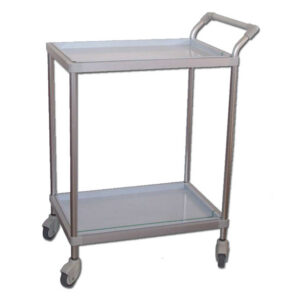
Deluxe medical trolley – 65 x 45 x H 80 cm, light anodised alloy and stainless steel shelves (Ref. 27460 · SKU GM27460)
328,70 € In stockAdd to basket -
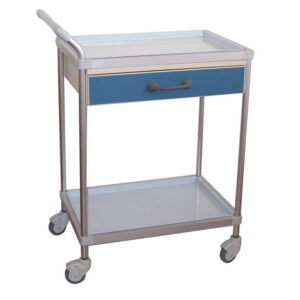
Deluxe medical trolley with 1 drawer – 65 x 45 x H 80 cm, light anodised alloy and stainless steel shelves (Ref. 27461 · SKU GM27461)
465,50 € In stockAdd to basket -
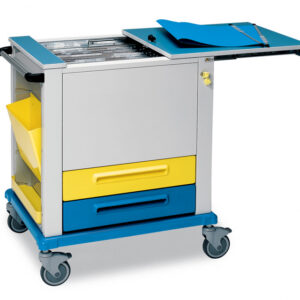
Medical Records Trolley with Sliding Lid · A3/A4 Format · Epoxy Steel and Technopolymer Plastic Structure · 820×640×h 1,000 mm (Ref. 27490)
2.546,00 € In stock🚚 Bulky deliveryAdd to basket -
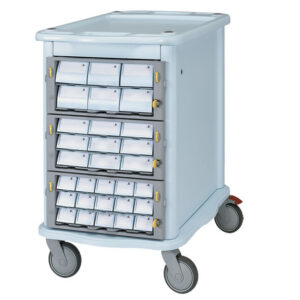
Double-Sided Pharmacy Trolley – 3 Large Drawers + 30 Single-Dose Cassettes (Ref. 27499) | Unit-Dose Medication Trolley with Locking System
4.607,50 € In stockAdd to basket -
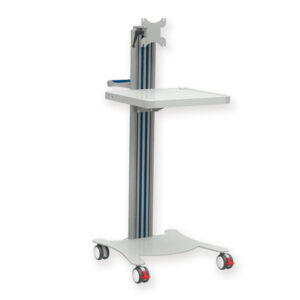
Super Easy multifunctional medical trolley with shelf – Medical equipment trolley with robust base and shelf, Ø 65 mm wheels with brake (Refs. 27869-71)
Price range: 408,50 € through 583,30 € In stockSelect options This product has multiple variants. The options may be chosen on the product page -
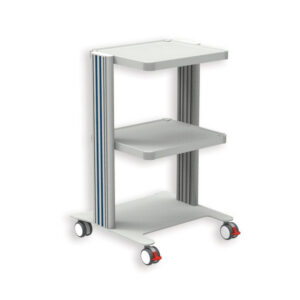
Medical Trolley EASY CART with 2, 3 or 4 Trays 40×36 cm and Base – Aluminium Structure and Twin Castors Ø 65 mm (Ref. GM27880 / GM27881 / GM27882)
Price range: 454,10 € through 703,00 € In stockSelect options This product has multiple variants. The options may be chosen on the product page -
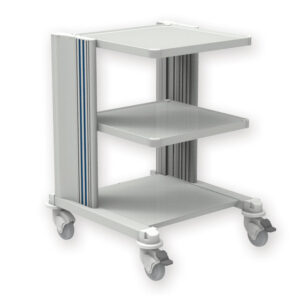
PRO CART Medical Trolley with 2 Trays of 50×50 cm and Base – Height 80 cm (Ref. 27885) | SKU GM27885
1.463,00 € In stockAdd to basket -
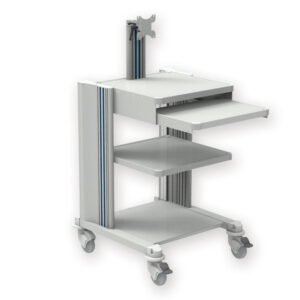
PRO CART Medical Trolley with 2 Trays, Keyboard Support and Monitor Support (Ref. 27887)
1.995,00 € On orderAdd to basket