
Bandages: buying guide
98 products in the catalogue
A bandage is a strip of fabric, elastic or not, that is wound around a part of the body to support or secure it. In healthcare a wide variety of constructions coexist: elastic gauze, crepe, cohesive, adhesive, compression-retention, tubular net bandages and taping tapes. Each serves a different function and they are not interchangeable.
The choice should start from the function the bandage has to fulfil and not just its size. In professional purchasing, the criteria that most influence the decision are the material, the presence or absence of latex, elasticity, the fixation system (cohesive or adhesive) and width and length. This guide sets out those criteria so that the selection fits each use.
Other related families
-
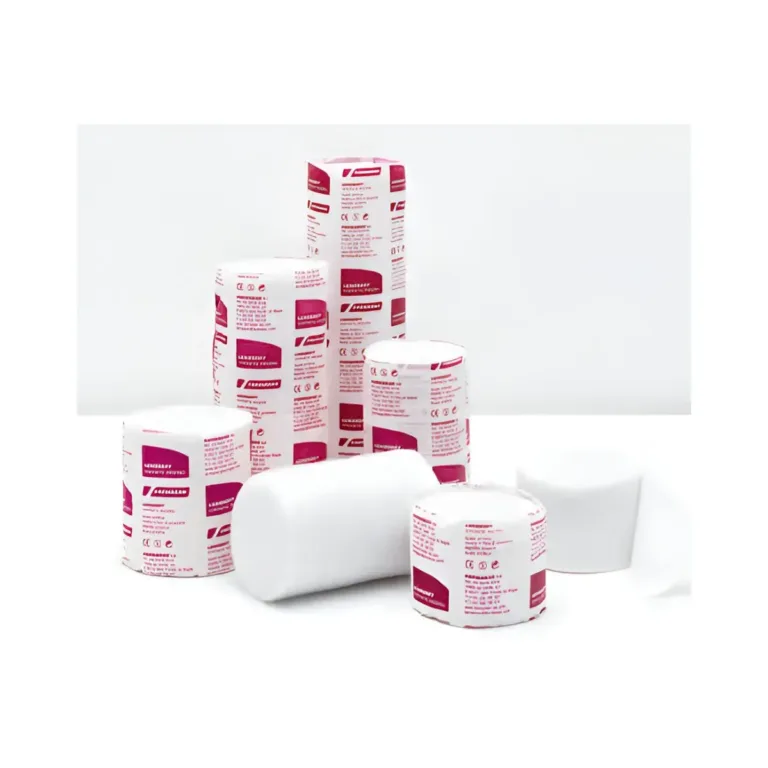
 Padding Bandage
Padding that protects the skin and is combined with other bandages.
-
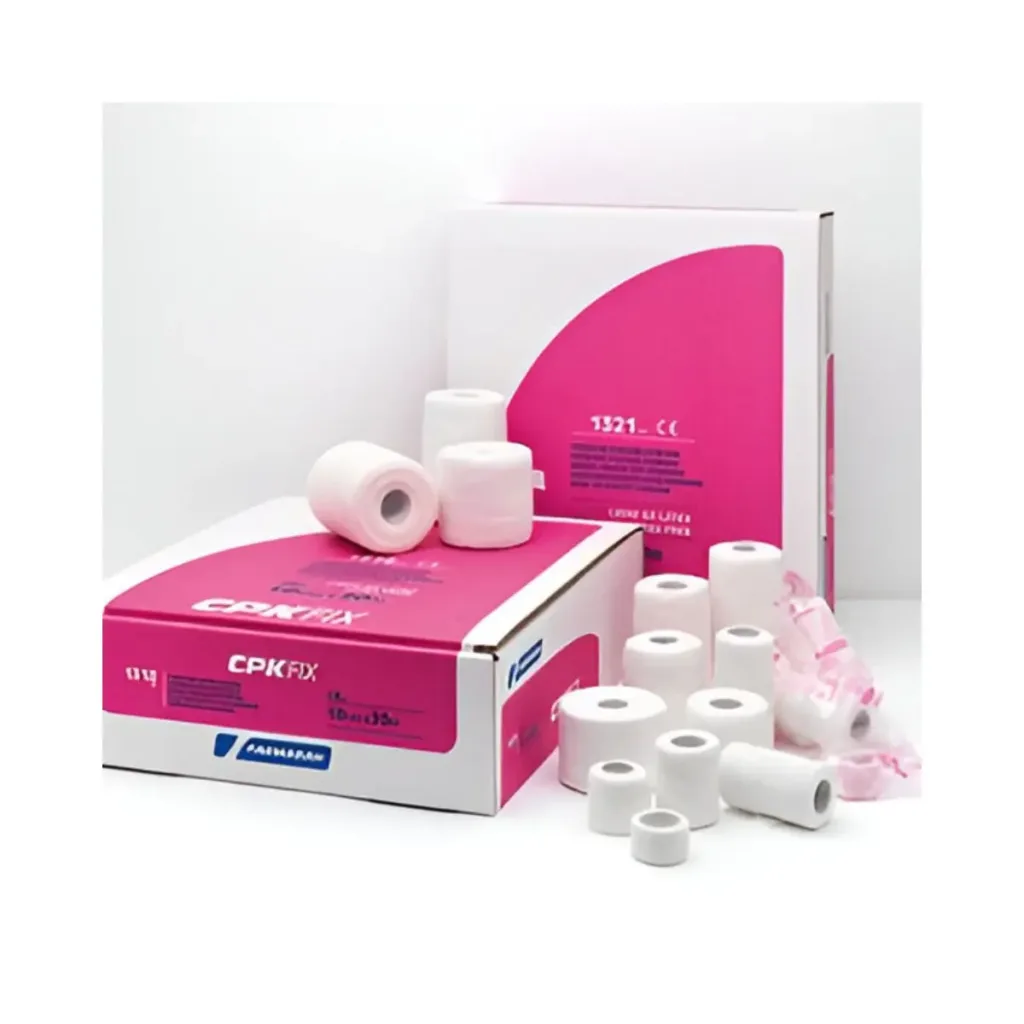
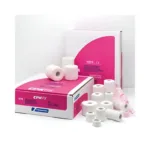 Latex-Free Cohesive Fixation Bandage
Sticks only to itself and contains no latex, which simplifies securing dressings.
-
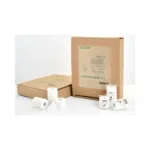 Elastic Adhesive Bandage
Fixes to the skin and to the bandage itself; the option when firm support is needed.
-
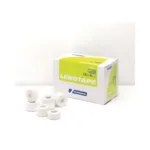 Rigid Sports Tape
Rigid, non-elastic cotton tape for functional bandaging and taping.
-
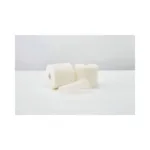 Polyurethane Foam Bandage
Foam padding to protect the skin under bandages.
Products in this guide
- Cotton 25
- Nylon / polyamide 18
- Polyester 18
- Non-woven 13
- Viscose 13
- Polypropylene 8
- Latex 7
- Polyurethane 2
- Latex-free 52
- With latex 5
- Vapour 35
- Ethylene oxide 8
- Radiation 5
- Otros colores 26
- Marrón 4
-
Sale!
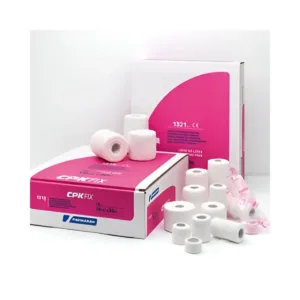
Latex-free cohesive fixation bandage 8 cm x 10 m CPK FIX — Elastic roll of 70 % viscose and 30 % polyamide, self-adherent and sterilisable by steam (Ref. CPKFIX1322)
Original price was: 45,57 €.37,29 €Current price is: 37,29 €. In stockAdd to basket -
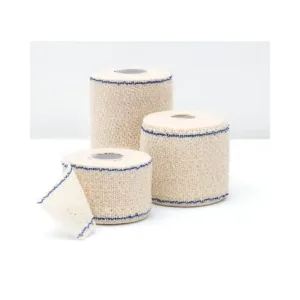
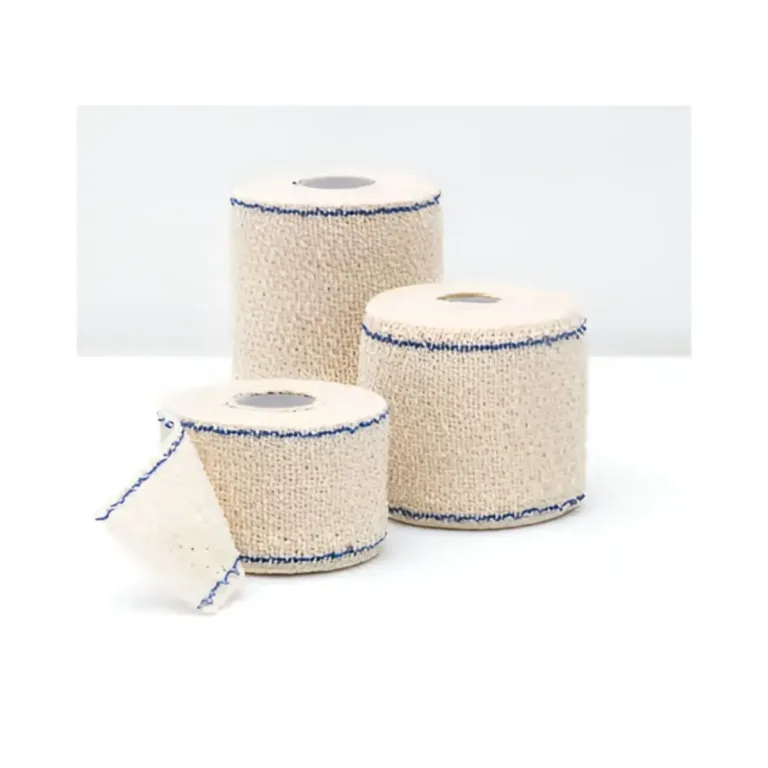
Elastic Crepe Bandage E.P.S. 10 cm x 10 m Latex-Free – Non-Slip Cotton for Dressing Fixation, Joint Support and Soft-Medium Compression | KREPEFIX1213
86,31 € In stockAdd to basket -
Latex-free cohesive fixation bandage 8 cm × 20 m CPK FIX (Ref. CPKFIX1316) — Elastic roll of 70 % viscose and 30 % polyamide, steam sterilisable. Box of 16 units
52,44 € In stockAdd to basket -
Latex-free cohesive fixation bandage 12 cm × 4 m — Elastic roll of viscose and polyamide, steam sterilisable (Ref. CPKFIX1313)
25,64 € In stockAdd to basket -
Sale!
Cohesive fixation bandage, latex-free, 6 cm × 20 m — Elastic roll of viscose and polyamide, steam sterilisable (Ref. CPKFIX1314)
Original price was: 45,89 €.28,50 €Current price is: 28,50 €. In stockAdd to basket -
Latex-free cohesive fixation bandage 4 cm × 20 m CPK FIX — Elastic fabric of 70 % viscose and 30 % polyamide, sterilisable by steam (Ref. CPKFIX1315)
28,98 € In stockAdd to basket -
Latex-free cohesive fixation bandage 12 cm × 20 m — CPK FIX range, elastic fabric 70% viscose / 30% polyamide, steam sterilisable, box of 18 rolls (Ref. CPKFIX1319)
80,21 € In stockAdd to basket -
Latex-free cohesive fixation bandage 8 cm × 4 m — Elastic roll of viscose and polyamide, sterilisable by steam (Ref. CPKFIX1311)
52,28 € In stockAdd to basket
Buying and selection tips
-
Material according to the bandage function
Elastic crepe bandages are used for support and fixation, cohesive bandages are made from non-woven fabric with an elastomer, elastic absorbent gauze bandages are supplied individually packed, and tubular net bandages are chosen by size. Define the function before choosing the material.
-
Check for latex
If there is skin sensitivity, it is advisable to choose a synthetic bandage that contains no latex, such as the cohesive bandages stated as latex-free. Some adhesive bandages include components of natural origin, so check the composition before confirming the order.
-
Cohesive is not the same as adhesive
A cohesive bandage sticks only to itself and not to the skin, which makes it practical for securing dressings. An adhesive bandage has a layer of adhesive that fixes to the skin. Choosing one or the other changes how it is used and how well the skin tolerates it.
-
Sizes: width and length, relaxed or stretched
Bandages are described by width and length. For elastic adhesive bandages, some products state both the unstretched and the stretched length. Check which size each product refers to so you can compare products.
-
Elasticity and type of bandage
Elasticity indicates how the bandage behaves: there are non-adhesive elastic retention bandages, elastic cohesive bandages, adhesive stretch bandages and compression bandaging. Ask about the stated elasticity of each product and do not assume that bandages of different types are equivalent.
-
Tubular bandages and taping
Tubular net bandages are chosen by size and application site. For functional bandaging and taping there are rolls of kinesiology tape and rigid sports tape. Define the function and size before ordering.
Compatibility
- Surgical tape with bandages
- Surgical tape is used to secure the bandage itself; check that the width and type are suitable for the chosen bandage.
- Bi-elastic tubular bandage for securing dressings
- The tubular bandage is used to secure dressings; check the size against the application site.
Frequently asked questions
When is a cohesive bandage better than an adhesive one?
If you need to secure a dressing without sticking anything to the skin, the cohesive bandage is the option: it sticks only to itself. If you need fixation to the skin, the adhesive bandage has that layer of adhesive.
How do I know if I need a latex-free bandage for my order?
If your facility works with reactive skin, a synthetic latex-free bandage is preferable. It is worth checking the stated composition before confirming the order.
What size of tubular bandage do I need for the application site?
Tubular bandages come in numbered sizes, and the size is chosen according to the application site and not by length. Check the size stated for each product before ordering.
How do I choose between an elastic retention bandage and a cohesive one?
The non-adhesive retention bandage is held in place with its own fixation system, whereas the cohesive bandage sticks to itself. Compare the width, length and presentation of each product.
Which measurements should I compare on an elastic adhesive bandage?
Compare width, unstretched length and stretched length, which appear on some products. Two bandages with the same stretched length can have a different length at rest.
Common questions
Believing that any elastic bandage is suitable for compression
Not all elastic bandages are built to apply compression. Look at the type of bandage and its stated elasticity, and not only at whether the bandage is elastic.
Thinking that a cohesive bandage sticks to the skin
The cohesive bandage sticks only to itself, not to the skin. It is practical for securing dressings, but it is not suitable for direct fixation to the skin if that is what you need.
Assuming that all bandages are measured in the same way
Some products state the unstretched length and others the stretched length. Check which measurement each one refers to before comparing.
More products in this guide
-
Latex-free cohesive fixation bandage 6 cm x 4 m — Elastic roll of viscose and polyamide, sterilizable by steam (Ref. CPKFIX1310)
39,95 € In stockAdd to basket -
Latex-free cohesive fixation bandage 4 cm x 4 m — Elastic roll of viscose and polyamide, steam sterilizable (Ref. CPKFIX1309)
34,85 € In stockAdd to basket -
Latex-free elastic cohesive fixation bandage 10 cm x 20 m — Roll of viscose and polyamide, sterilizable by steam (Ref. CPKFIX1318)
57,60 € In stockAdd to basket -
Latex-free cohesive fixation bandage 2.5 cm x 4 m — Elastic fabric of 70% viscose and 30% polyamide, hypoallergenic and sterilizable by steam (Ref. CPKFIX1308)
31,89 € In stockAdd to basket -
Elastic cohesive fixation bandage, latex-free, 10 cm x 10 m — Roll of viscose and polyamide, sterilisable by steam (Ref. CPKFIX1323)
49,76 € In stockAdd to basket -
Latex-free cohesive fixation bandage 4 cm × 10 m CPK FIX — Elastic roll of 70 % viscose and 30 % polyamide, steam-sterilisable (Ref. CPKFIX1320)
51,46 € In stockAdd to basket -
Latex-free cohesive fixation bandage 6 cm x 10 m CPK FIX — Elastic viscose and polyamide roll, hypoallergenic and steam-sterilisable (Ref. CPKFIX1321)
40,05 € In stockAdd to basket -
Latex-free cohesive fixation bandage 12 cm x 10 m — Roll of viscose and polyamide, sterilisable by steam (Ref. CPKFIX1324)
59,95 € In stockAdd to basket