

Description
1. Introduction
The LP2824 thermal printer (ref. 00160851) is the 54 mm desktop solution for professional labelling in healthcare environments: printing of patient identification wristbands, sample labels, hospital pharmacy identifications and traceability barcodes. Its compact double-shell design and direct thermal printing technology guarantee reliable, long-lasting operation without ink, toner or ribbon consumables, reducing operating and maintenance costs at admission points, emergency departments, laboratories and inpatient units.
2. Technical explanation of the equipment
The LP2824 uses direct thermal printing: the printhead selectively applies heat to the paper, wristband or thermal label, and the image is printed instantly and permanently, without the need for ribbons or toner. Its resolution of 203 dpi (8 dots/mm) and speed of up to 102 mm/s (4 inches per second) enable fast, perfectly legible runs of small text, logos and 1D/2D codes.
It comes standard with three interfaces —RS-232 serial, Centronics parallel and USB— facilitating integration with hospital management systems (HIS/LIS), electronic health records and label printing software. The programming languages ZPL II and EPL2 coexist in memory, so it can replace printers from other brands by reusing existing label templates. Media auto-calibration, the OpenACCESS™ design and the double-walled ABS housing ensure easy consumable loading and a long service life.
3. Technical Specifications
| Characteristic | Specification |
|---|---|
| Model | LP2824 (reference Cahnos 00160851) |
| Print method | Direct thermal, no ink or toner |
| Resolution | 203 dpi (8 dots/mm) |
| Printhead width | 54 mm (nominal catalogue width; maximum print width 56 mm / 2.2″) |
| Printing speed | Programmable 51 – 76 – 102 mm/s (2, 3 and 4 ips), maximum 102 mm/s |
| Maximum print length | 991 mm (39″) |
| Connectivity | RS-232 serial with auto-detection port, Centronics parallel (36-pin) and USB |
| Memory | 8 MB SDRAM and 4 MB Flash standard; optional additional 64 MB Flash with real-time clock |
| Programming languages | ZPL II and EPL2 co-resident (EPL2 with line mode) |
| Supported media width | From 25.4 mm (1″) to 60 mm (2.36″) |
| Media thickness | 0.08 mm to 0.18 mm |
| Roll capacity | Up to 127 mm (5″) outer diameter; core 25.4 mm (1″) or 38 mm (1.5″) |
| Media types | Continuous roll, die-cut, fan-fold, labels, tag stock, continuous receipt and wristbands |
| Sensors | Transmissive (gap) and reflective (black mark); open head sensor |
| 1D barcodes | Code 11, Code 39, Code 93, Code 128, UPC-A/E, EAN-8/13/14, Interleaved 2 of 5, Industrial 2 of 5, Codabar, MSI, Plessey, POSTNET, LOGMARS and GS1 DataBar |
| 2D barcodes | PDF417, MicroPDF417, Data Matrix, QR, Aztec, MaxiCode, Code 49 and Codablock |
| Dimensions and weight | 111 x 216 x 171 mm (width x depth x height); 1.2 kg |
| Power supply | Auto-ranging power supply 100-240 V AC, 50-60 Hz |
| Operating conditions | 5 °C to 41 °C; humidity 10-90% non-condensing |
| Construction | Double-walled ABS housing, OpenACCESS™ design for easy media loading |
| Presentation | Per unit, with manual and label design software |
4. Equivalences and Cross-References
The following alternatives are offered as a category comparison: they share the same technology (direct thermal, 203 dpi) and a 2-inch print width (54-56 mm), but differ in speed, memory, connectivity or platform generation. They are not 1:1 interchangeable without verifying the driver, label format and the centre’s printing software.
| Manufacturer / Brand | Family / Model | Reference Code / SKU | Equivalence Level | Technical Differences / Remarks |
|---|---|---|---|---|
| Zebra Technologies | ZD410 (compact 2″ series) | ZD41022-D01E00EZ | Comparable by category (not interchangeable 1:1) | Direct thermal 203 dpi, maximum print width 56 mm, up to 6 ips (152 mm/s), USB + USB host + Ethernet; higher speed and memory than the LP2824, with standard network connectivity and no parallel port. |
| Honeywell | PC23d (EasyCoder, 2″ desktop series) | PC23DA0010021 | Comparable by category (not interchangeable 1:1) | Direct thermal 203 dpi, maximum print width 56 mm, up to 8 ips (203 mm/s), USB 2.0 with USB host, multilingual LCD display and real-time clock; does not include parallel or serial port as standard. Confirmed in the manufacturer’s technical datasheets and public catalogues. |
| TSC Auto ID | DH220 (official successor to the TDP-225 series) | DH220-A001-1001 | Comparable by category (not interchangeable 1:1) | Direct thermal 203 dpi, up to 203 mm/s, USB + RS-232 + Ethernet + USB host, real-time clock and buzzer; 128 MB Flash / 128 MB DRAM memory. Superior performance and connectivity, DH series format that replaces the previous 54 mm generation. |
There is no equivalence table validated by the manufacturer for this reference; the indicated equivalences have been cross-checked against public documentation from the cited manufacturers (technical datasheets, manuals and official pages). Consult the technical department before use in tenders.
5. Selection tips and variants of interest
Compatible wristbands: the LP2824 accepts rolls with a maximum external diameter of 127 mm, so it is compatible with the Cahnos range of thermal wristbands in rolls of 250 units and a maximum diameter of 120 mm: SIMPLE 25 x 241 mm (ref. 00160801), LITE 25 x 280 mm (refs. 00160811 to 00160818) and MED 29 x 292 mm adult / 25 x 190 mm child / 25 x 152 mm baby (refs. 00160821 to 00160829). Its 54 mm print width is the ideal format for 25 and 29 mm patient identification wristbands.
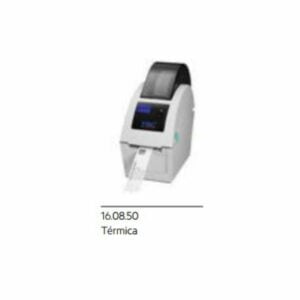
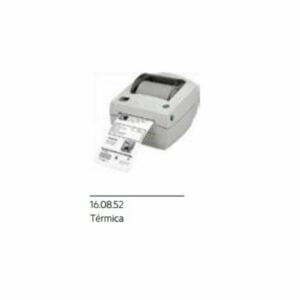
Catalogue variants: if network connectivity is a priority, the TDP-225e (ref. 00160853) offers the same 54 mm width with USB and Ethernet. For a 104 mm width, the LP2844 (ref. 00160852) maintains the same serial/parallel/USB connection scheme, and the TSC TTP-245+ (ref. 00160855) covers that width with USB. If you only need USB in 54 mm, the TDP-225 (ref. 00160850) is the most economical option in the range.
Network environment: the LP2824 comes standard with USB, serial and parallel; if printing must be shared between several workstations or integrated into the hospital information system, consider a model with Ethernet or a network print server.
Prior testing: before going into production, perform a test print with the final wristband or label to calibrate density, gap sensor alignment and barcode readability with the centre’s scanners.
Reviews
There are no reviews yet.